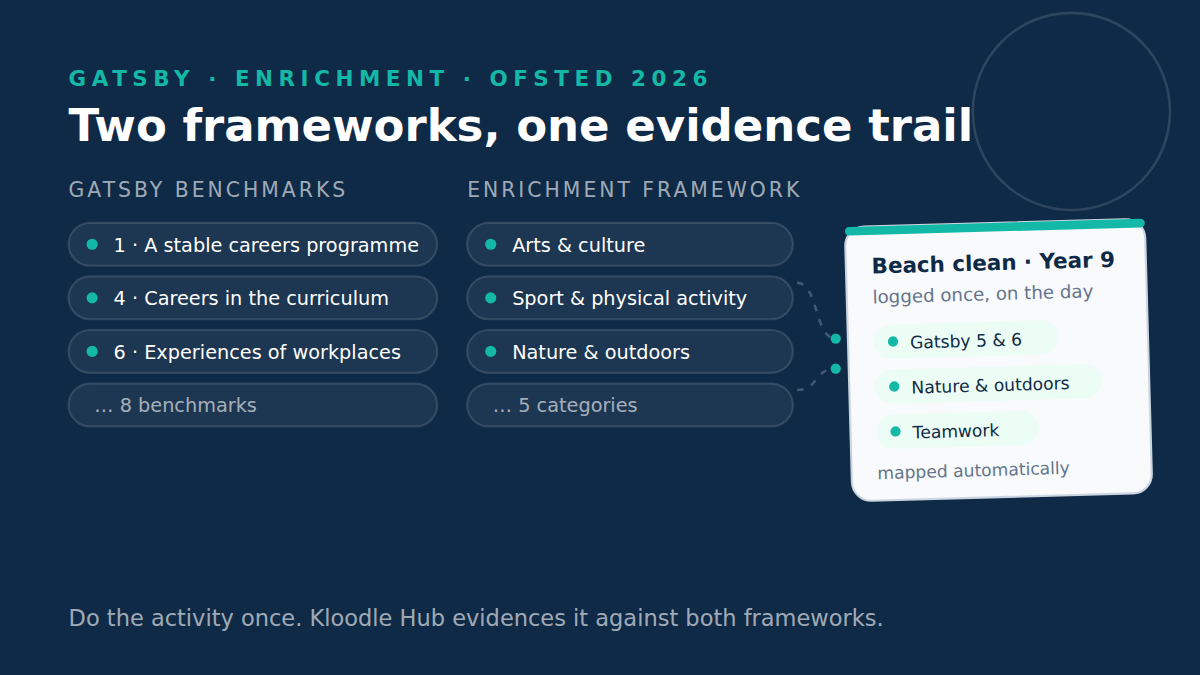
The Gatsby Benchmarks and Enrichment, in a Nutshell
What they mean, why they matter, and the one thing which trips schools up
Ask most teachers about the Gatsby Benchmarks and you tend to get a slightly weary look. Another framework, another thing to log, yet another acronym to learn on top of a full timetable.
Here is the reassuring bit: you are almost certainly doing most of it already.
Gatsby, in plain English
The eight Gatsby Benchmarks are the national standard for careers education in England. They were developed by the Gatsby Foundation and adopted by the Department for Education, and every school is expected to work towards them as part of its statutory duty on careers guidance.
Forget the numbered list for a moment. The spirit of Gatsby is simple. Every young person should leave school having had real contact with the world of work. Not a leaflet. Not a single assembly in Year 11. A stable, planned programme which runs across the years, gives every pupil what they actually need rather than a one-size offer, links their subjects to real careers, and puts them in front of real employers, real workplaces and one-to-one guidance.
That is the whole idea. Careers education which feels real, not just a bolt-on. Alongside it sits the government's commitment to two weeks of work experience for every young person, which is Gatsby in its most concrete form.
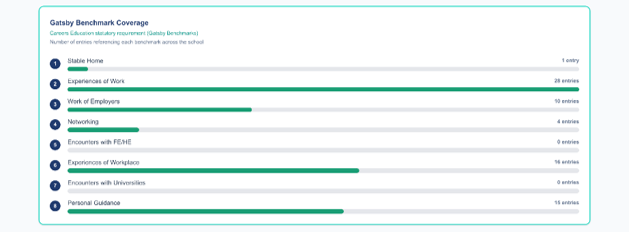
This is also where Kloodle sits in the background quietly earning its keep. Log an activity and the trained AI reads it and tells you which Gatsby benchmarks it meets. No cross-referencing by hand, no guessing. The mapping is all done for you.
Enrichment, and what changed in 2026
Enrichment sits right next to careers guidance and this is where things have moved recently.
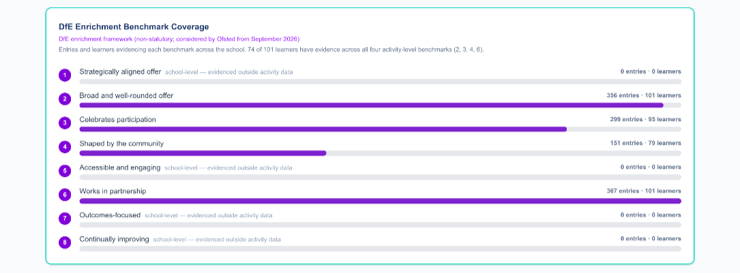
In June 2026 the Department for Education published a new Enrichment Framework, built around eight benchmarks. It grew out of the Curriculum and Assessment Review, and it applies right across the system, from primary and secondary through to colleges, special schools and alternative provision.
It is worth clearing up one thing which can be confusing, because there are two numbers in play. The eight benchmarks describe how good your enrichment offer is: is it strategic, broad, well communicated, inclusive, built on partnerships, outcomes-focused, and always improving. Sitting inside one of those benchmarks are five categories, which describe what pupils actually do: arts and culture, sport and physical activity, nature and the outdoors, civic engagement, and wider life and future skills.
So, the eight are about quality and reach. The five are about breadth of activity. A strong school can show all eight across all five.
The framework is not statutory. You are not breaking the law if you ignore it. However, here is the part which matters. From September 2026, Ofsted looks at enrichment as part of its judgement on personal development. There is funding attached for a first wave of schools in disadvantaged areas, but funded or not, every school will be looked at against the same benchmarks. While nobody is forcing your hand, inspectors will be asking what your enrichment offer looks like and, crucially, what difference it makes.
What counts as enrichment? More than you probably think. A trip to the theatre. The STEM club. The Duke of Edinburgh cohort trudging across a hill in the rain. The debating society, the volunteering, the sports teams, the mock interviews, the student council. All of it. Enrichment is simply the good stuff which happens around the edges of the timetable and shapes young people’s character as much as any exam. Which is why the reassuring line from earlier holds. You are already doing this and schools are full of it.
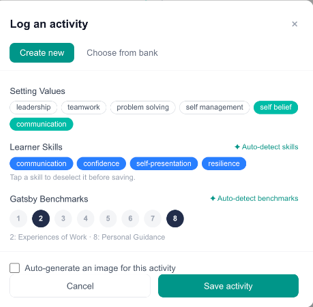
Kloodle does the same job here as it does for Gatsby. Log the activity and the AI tells you which enrichment benchmarks it hits, across both the eight and the five categories, tagged as you go. So, the framework stops being another thing to map by hand and becomes something which builds itself in the background.
The real challenge is proof
Here is where Gatsby and enrichment meet. A lot of the enrichment schools already run also delivers Gatsby. An employer coming in to run a workshop is an encounter with an employer. A workplace visit is an experience of a workplace. A careers fair, a mentor, an enterprise project, all of it doubles up. The DfE says as much itself: careers guidance and enrichment both build the transferable skills young people need for their futures.
If schools are already doing the activity, and it already maps onto the benchmarks, where is the problem? The problem is proof.
This is the bit which trips schools up, and it is worth being honest about. Doing the activity is one thing. Evidencing it is another. Ofsted's renewed interest in personal development is not really about whether you run enrichment. It is about whether you can show it is purposeful, broad, reaching every pupil, and actually making a difference to individual young people. Pastoral warmth on its own is not enough. Inspectors want the thread from activity to outcome.
And that is genuinely hard. Most schools track enrichment in a patchwork. A spreadsheet here, a sign-up sheet there, a teacher's memory of who turned up. Compass and Compass+ help on the careers side, but the fuller picture, the skills a young person built, the confidence they gained, and the pupils who never signed up at all, tends to live in a dozen places or nowhere.
This is the gap Kloodle has been designed to close. And the real benefit, the one people keep coming back to, is that it does the thinking for you.
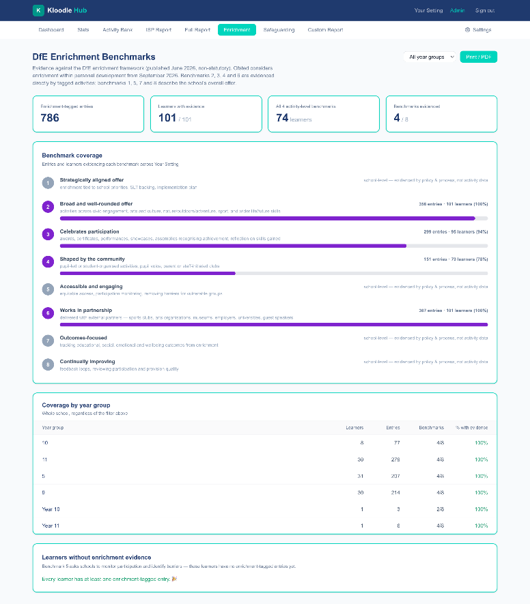
Someone logs something which happened anyway. A moment in a lesson, a careers session, an enrichment activity, a breakthrough in PE. It can be a teacher, a teaching assistant, or the young person themselves. They give it a title and, if they want, one sentence on what they did. That is the whole job. Kloodle does the rest.
A click, and the trained AI writes the description and works out which skills, which Gatsby and enrichment benchmarks, and which ISP targets it feeds. Another, and it generates the learner reports, mapped to those benchmarks. Another still, and it pulls the whole picture together, for every child, every class, the whole year group and the whole school, writes the reports for SLT, the MAT or Ofsted, and even flags which benchmarks to target next. The activity was always happening. Kloodle just turns it into evidence without anyone having to sit down and build it.
Which means the thing it really hands back is time. Hours, and across a year, days. Less of it lost to spreadsheets and report writing, more of it spent on the young people, which is why anyone came into this work in the first place.
None of that replaces the work. The trip, the workshop, the mentor, the club, that is yours, and it always will be. Kloodle just makes sure none of it goes unseen.
The reassuring version
When the frameworks land on your desk, and they will keep landing, try to hold onto the reassuring version. This is not a demand to do more for its own sake. It is a prompt to notice, value and evidence the brilliant things already happening in your school.
Gatsby gives careers education a skeleton. The enrichment benchmarks give the wider stuff its due. And the schools which come out of this well will not be the ones which suddenly invent a hundred new activities. They will be the ones which can finally show what they were doing all along.
Further reading
The enrichment framework for schools and colleges (DfE, GOV.UK): gov.uk/government/publications/the-enrichment-framework-for-schools-and-colleges
The eight enrichment benchmarks in full (DfE, GOV.UK): gov.uk/.../enrichment-benchmarks