Background to the Alternative Provision Problem
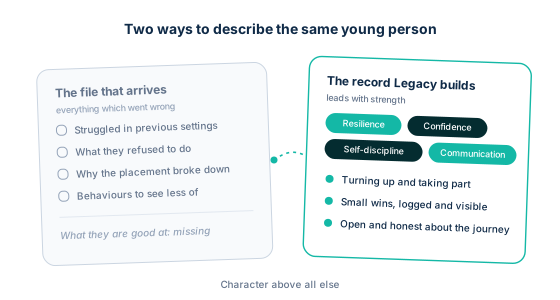
Most young people who end up in alternative provision (AP) arrive with a thick file, usually telling you everything which has gone wrong. Where the young person struggled, what they refused to do, why the last placement broke down. What it almost never tells you is what they are good at.
Legacy AP is trying to change that. It is a new alternative provision in Burnley, built almost entirely by volunteers, local tradespeople and college students who gave their time to turn an empty space in an old mill into somewhere young people would actually want to do things. It opened its doors this year to a small first cohort. The model is simple to say and hard to do: Character above all else.
The gym becomes the classroom
At Legacy, the gym becomes the classroom.
It looks like a slogan, but it's way more than that.
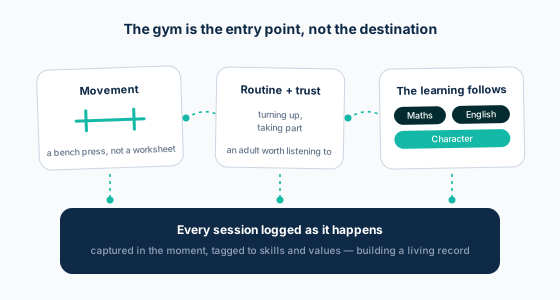
Movement and exercise are the entry points. For a young person who has switched off from school, who has been asked to leave more than one, who does not trust adults and does not see the point of a desk, a bench press is a lot less threatening than a worksheet. You start at the level where the students are. The key is to build routine and build trust. Then, once the young person is turning up and taking part, the learning follows. Maths, English, personal development and, very importantly, character.
Here is the problem every alternative provision knows. Getting a young person to engage again is one thing. Proving it is another. The commissioning school needs to see progress, as does the local authority. More often than not, evidencing that progress is the responsibility of staff who are already stretched, and it has to be written up by hand, long after the moment has passed. That way, the story of what changed gets lost.
This is where Legacy does something different.
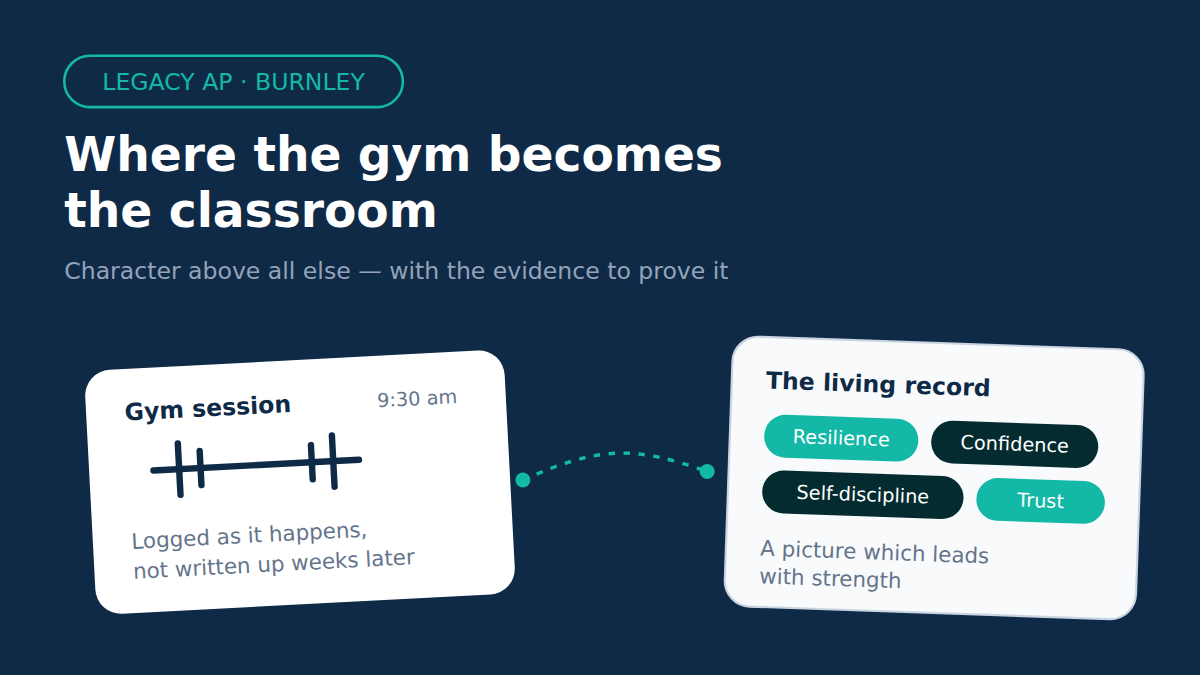
Every session is logged as it happens. Not written up weeks later from memory, but captured in the moment and tagged to the skills and values the young person is showing. Skills like resilience, confidence, self-discipline, communication. Over time, that builds into a living record, a picture of a young person which is open and honest about the journey and, for once, leads with strength.
Where Kloodle comes in
That living record has a name. Legacy uses a digital platform called Kloodle to build it.
Kloodle is a skills and character platform, which takes what a young person does day to day like the gym sessions, the conversations, the small steps forward, and turns it into an evidenced record tagged to skills, values and targets. Nothing has to be written up from scratch later. It is captured as it happens.
Why does that matter for a setting like Legacy?
Because the work here is relational and easy to lose. A breakthrough in a conversation does not leave a paper trail on its own. Kloodle gives that work a shape the placing school and the local authority can see, and it does it without pulling staff away from the young people. When a young person moves on, the record goes with them, so nothing gets lost.
One young person, one first cohort
The first cohort of students has just arrived at Legacy. Take one young person from that first cohort. He arrived the way a lot of them do. He had not managed well in previous settings. His plan set out the behaviours everyone wanted to see less of: leaving without permission; resisting adults; not turning up. The kind of targets which describe a problem rather than a person.
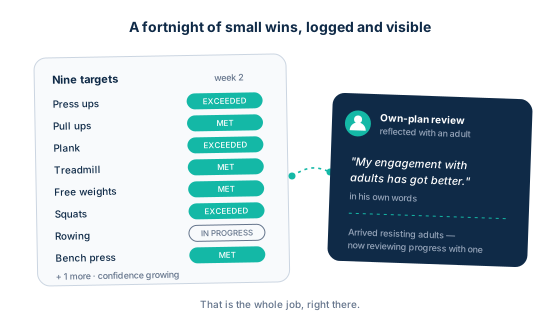
Legacy started with the gym. A structured programme with real targets: press ups, pull ups, planks, the treadmill, free weights. Nine targets in all. Within a fortnight he had met or exceeded most of them. Small wins, logged and visible, stacking up bit by bit. Confidence growing.
The gym was never the main point; it was just the starting place. One of the early sessions was not a workout at all, it was a conversation. The head of school sat down with him and they talked honestly. Why he had left schools before. What he liked doing. Why he stayed up all night. They talked about the things each of them found hard, and how exercise helped. That is not a lesson you will find on a timetable. It is the moment a young person decides an adult is worth listening to.
And then something happened which tells you the model is working. He sat down and reviewed his own plan. He looked at his own targets and recognised, in his own words, that his engagement with adults had got better.
Think about that.
A young person who arrived resisting adults, choosing to reflect on his own progress with one. That is the whole job, right there.
What the placing school and the local authority can look at
Because all of this development was captured as it happened, the placing school and the local authority can see it. It is not a hand-written summary knocked together before a review, it is a professional, evidenced record about building skills, meeting targets, improving attendance and engagement. The character work is made visible instead of left as a nice story someone tells in a meeting.
That record does two jobs at once. It shows the young person how far they have come, which matters a lot. It also gives the people who placed them the evidence they need to know the placement is working.
There's another key benefit. Woven through those gym sessions and conversations are the beginnings of careers work, activities such as talking about pathways, reflecting on strengths, exploring what a future in fitness, or trades, or anything else might look like. Six of the eight Gatsby Benchmarks are already showing in the record, without anyone having to run a separate tracking exercise to prove it.
What other settings can take from this
So what can other settings take from this? Quite a few things.
Start where the young person is, even if that is a squat rack and not a desk. Routine and relationship come before curriculum, not the other way round. And evidence the work as you go, because the progress you cannot see is the progress you cannot prove.
Legacy is early. This is a first cohort and there is a long way to travel. But the approach is right. Meet young people with belief instead of a file full of everything which went wrong. Give them something to turn up for. And keep a record which, for once, tells them what they are capable of.
Character above all else and there's the evidence to prove it.